

- Shower filters are designed to reduce chlorine — and that's what they do best. KDF55, activated carbon, and calcium sulfite are the proven media.
- Chlorine and chloramine require different solutions. If your water utility uses chloramine, a standard shower filter will not effectively reduce it.
- More stages does not mean better filtration. A 16-stage filter and an 8-stage filter often contain the same amount of media — the difference is marketing.
- Most shower filters — including ours — do not carry NSF/ANSI 177 performance certifications. We are transparent about that.
- A shower filter addresses what touches your skin. Your drinking water requires a completely different level of filtration.
- What's Actually in Your Shower Water?
- What Shower Filters Can — and Cannot — Do
- The Filtration Media That Actually Matters
- Chlorine vs. Chloramine: Why This Matters
- The Certification Problem
- What to Look for When Comparing Filters
- Why "More Stages" Doesn't Mean Better
- When a Shower Filter Isn't Enough
- Our Approach: Honest Products at Fair Prices
- Replacing Your Cartridge: What to Know
- Matching the Right Solution to Your Situation
- Frequently Asked Questions
If you've ever searched for a shower filter online, you already know the problem: every brand claims to be the best, most of them promise to remove everything from chlorine to heavy metals to PFAS, and almost none of them back those claims with third-party testing.
We sell a shower filter — so you might expect us to do the same thing. We're not going to.
Instead, this guide walks you through what shower filters can realistically do, what they can't, which filtration media actually works, and how to determine what your water needs. If our shower filter is the right fit, we'll tell you. If you need something more, we'll tell you that too.
What's Actually in Your Shower Water?
If you're on municipal water in the U.S., your water is treated at a local facility before it reaches your home. That treatment process is designed to make water safe — but "safe" and "ideal for your skin and hair" are two different standards.
Up to 4 mg/L permitted by the EPA as a residual disinfectant. Strips natural oils from skin and hair. The source of that familiar pool-like odor in your shower.
A chlorine-ammonia compound used by utilities serving over 68 million Americans. More stable than chlorine, but significantly harder to remove — and standard shower filters are not effective against it.
Trihalomethanes (THMs) and haloacetic acids (HAAs) form when chlorine reacts with naturally occurring organic matter in the water. In a hot shower, some of these compounds become volatile and can be inhaled as steam. Read the research on chlorine exposure and long-term health.
Hard water minerals — calcium and magnesium — are present in over 85% of U.S. homes. Hard water leaves scale on fixtures, reduces soap lather, and contributes to dry skin and hair. It is important to understand that shower filters cannot soften water. Hard water requires a water softener or conditioner installed at the main water line.
What Shower Filters Can — and Cannot — Do
This is where most shower filter marketing falls apart. Here is an honest breakdown of what you can and cannot expect:
| Claim | Reality | What You Should Know |
|---|---|---|
| Reduces chlorine | Yes | KDF55, calcium sulfite, and activated carbon are all proven to reduce chlorine. This is what shower filters are primarily designed to do. |
| Reduces chloramine | Limited | Chloramine requires significantly more contact time than shower flow rates allow. No shower filter holds third-party certification for chloramine removal. A whole-home system is the proper solution. |
| Reduces sediment | Yes | Most multi-stage filters include mesh screens that capture rust, dirt, and particulates — improving water clarity and protecting your shower head. |
| Removes heavy metals | Minimal | KDF media may reduce trace amounts of some dissolved metals, but shower filters are not designed or certified for heavy metal removal. If lead or other metals are a concern, test your water and consider a certified point-of-use system. |
| Removes PFAS | No | PFAS removal requires reverse osmosis or specialized activated carbon with extended contact time. Standard shower filters cannot reduce PFAS. |
| Softens hard water | No | No shower filter removes calcium and magnesium. Some filters reduce chlorine, which can make water feel softer on skin — but they do not address water hardness. |
| Improves skin and hair | Likely | By reducing chlorine — a known skin and hair irritant — many customers report softer skin, reduced dryness, and healthier-looking hair. Results vary based on incoming water quality and individual sensitivity. |
Shower filters are effective tools for reducing chlorine and improving the daily shower experience. They are not whole-home water treatment systems, and any brand positioning them that way is overclaiming.
The Filtration Media That Actually Matters
Not all shower filters are created equal, but most rely on the same core materials. Understanding what's inside your filter matters more than the brand name on the outside.
| Media Type | How It Works | Best For | Limitations |
|---|---|---|---|
| KDF55 | A copper-zinc alloy that uses a redox reaction to convert chlorine into harmless chloride. Also inhibits bacterial growth within the filter housing. | Chlorine reduction in hot water. Remains effective at shower temperatures and flow rates. | Does not soften water. Limited effectiveness against chloramine. |
| Activated Carbon | A highly porous material — typically coconut shell — that traps chlorine and VOCs through adsorption. | Chlorine and odor reduction. Effective in cold water conditions. | Less effective in hot water. Requires adequate contact time — fast flow reduces performance. |
| Calcium Sulfite | Rapidly reacts with chlorine to convert it into chloride. Works quickly even at high flow rates. | Chlorine reduction in both hot and cold water. Well-suited to shower conditions. | Does not address chloramine. Limited effectiveness against other contaminants. |
| Vitamin C (Ascorbic Acid) | Chemically neutralizes both chlorine and chloramine through a rapid reaction. | The only media with documented effectiveness against chloramine in shower-speed filtration. | Dissolves quickly — cartridges require replacement every 2–4 weeks. Significantly higher ongoing cost. |
| Catalytic Carbon | A modified activated carbon with an enhanced surface structure capable of decomposing chloramine. | Chloramine and disinfection byproduct reduction. Standard in whole-home systems. | Requires extended contact time — more effective in whole-home systems than at shower flow rates. |
The best shower filters combine multiple media types — typically KDF55 for hot-water chlorine reduction, activated carbon for odor and VOC adsorption, and calcium sulfite for rapid chlorine conversion. This layered approach compensates for the individual limitations of each media and extends the effective life of the cartridge.
Chlorine vs. Chloramine: Why This Matters for Your Filter Choice
This is the single most important variable most shower filter shoppers overlook: your water utility uses either chlorine or chloramine as its primary disinfectant, and that distinction determines what kind of filtration will actually work for you.
A standard multi-stage shower filter with KDF55, activated carbon, and calcium sulfite will effectively reduce chlorine at the shower head. This is the scenario where shower filters perform best — and where our product is the right fit.
Standard shower filters — including ours — are not effective against chloramine. The most effective solution is a whole-home filtration system with catalytic carbon media that treats water at the point of entry, before it reaches any tap or shower in your home.
How to Find Out Which Disinfectant Your Utility Uses
Check your utility's annual Consumer Confidence Report (CCR) — it is publicly available and will list which disinfectant is used in your distribution system.
Call your local water utility directly — they are required to answer this question.
Fastest option: use our AI Water Concierge — enter your zip code and it will pull your local water data and recommend the right solution for your home.
Not Sure What's in Your Water?
Enter your zip code and our AI Water Concierge will pull your local water report and tell you exactly what you're dealing with — and what to do about it.
Talk to Our Water ConciergeThe Certification Problem: What Most Brands Won't Tell You
Here's an uncomfortable truth about the shower filter category: most filters — including many that cost $100 or more — do not carry third-party performance certifications.
The gold standard for shower filter certification is NSF/ANSI 177, which independently verifies chlorine reduction at shower flow rates and temperatures. To earn this certification, a filter must be tested by an accredited laboratory and proven to reduce at least 50% of chlorine across a specified number of gallons.
Most shower filter brands do not hold this certification. Instead, they use language designed to imply verification that doesn't exist:
"Uses NSF-certified media" — The raw materials meet safety standards for composition. This does not mean the assembled filter has been independently tested for performance.
"Tested in multiple labs" — Without naming the labs, specifying what was tested, or making results publicly available, this claim is unverifiable.
"Exceeds certifications" — A phrase that avoids disclosing the absence of any certifications at all.
"Certified" with no standard cited — Deliberately vague language designed to imply independent verification that does not exist.
NSF/ANSI 372 — This certification means the product is lead-free in its construction materials. It does not mean the filter removes lead from water. Some brands use this to imply lead removal capability, which is misleading.
Our 8-Stage Shower Filter does not carry NSF/ANSI 177 performance certifications. The filtration media we use — KDF55, activated carbon, and calcium sulfite — are well-established and widely used across the industry, but we will not claim certified performance we cannot document. If third-party certification is a priority, look specifically for NSF/ANSI 177 and verify the claim directly on the NSF website or the WQA product finder.
What to Look for When Comparing Shower Filters
The factors that actually determine filter performance — ranked in order of importance. Notice what does not appear on this list: number of stages.
The media determines what the filter actually reduces. Look for KDF55, activated carbon, and calcium sulfite. Everything else is packaging.
NSF/ANSI 177 for chlorine reduction. Always verify on nsf.org or wqa.org — do not rely on the brand's own website to confirm certification status.
A depleted filter does not filter anything. Most shower filters last 3–6 months. Knowing the actual lifespan matters more than the stage count — replace on schedule.
The purchase price is just the entry point. Calculate true annual cost: filter price + (cartridge price × replacements per year). A $40 filter with $20 cartridges every 3 months costs $120 per year.
Most shower filters fit standard 1/2" threaded shower arms. Confirm before purchasing if you have a handheld, rain, or dual-outlet setup.
Some filters noticeably reduce flow rate. Read reviews that specifically address water pressure. A modest reduction can indicate good filtration. A significant drop typically signals poor filter design or a clogged cartridge.
Why "More Stages" Doesn't Mean Better Filtration
A 15-stage or 20-stage filter is not necessarily better than an 8-stage filter. What determines performance is the quality and volume of the filtration media inside — not the number of layers the marketing department decided to count.
| High Stage-Count Filter (e.g. 16-Stage) | GoodFor 8-Stage Filter | |
|---|---|---|
| Total Media Volume | Same physical volume — spread thin across many layers | Same physical volume — concentrated in the media that performs |
| Layer Composition | 3–4 effective layers padded with mineral balls, tourmaline, and ceramic beads that contribute minimal filtration | KDF55, activated carbon, and calcium sulfite — each given more contact time with the water |
| What the Stage Count Reflects | A larger number on the marketing copy | A deliberate decision to prioritize effective media over stage count |
More contact time with proven media produces better chlorine reduction. More stages with thinner layers of filler material produces a larger number on the packaging. Our 8-Stage Shower Filter was designed with that tradeoff in mind — we prioritized the media that reduces chlorine and gave it more room to work.
When a Shower Filter Isn't Enough
A shower filter is an effective starting point — affordable, straightforward to install, and well-suited to chlorine reduction at a single shower head. There are situations, however, where a different or more comprehensive solution is warranted:
Standard shower filters cannot effectively reduce chloramine. The correct solution is a whole-home filtration system with catalytic carbon media that treats water at the point of entry — before it reaches any tap, shower, or appliance in your home.
Shower filters do not remove calcium or magnesium. If scale buildup, dry skin, and ineffective soap lather are your primary concerns, the correct solution is a water softener or salt-free conditioner installed at the main water line.
These require certified filtration systems — typically reverse osmosis for drinking water, or specialized whole-home add-on filters designed for specific contaminant removal.
A shower filter treats one point of use. If you want filtered water throughout your entire home — every bathroom, the kitchen, your water heater, your laundry — a whole-home system is the appropriate investment.
Many GoodFor customers start with a shower filter, experience the difference filtered water makes, and upgrade to whole-home filtration over time. The shower filter continues to work as an additional layer of protection even after a whole-home system is installed.
Our Approach: Honest Products at Fair Prices
We sell an 8-Stage Shower Filter that uses KDF55, activated carbon, calcium sulfite, tourmaline, and ceramic filtration media. It is designed to reduce chlorine and odor at the shower head. It installs in under five minutes with no tools and fits all standard 1/2" threaded shower arms.
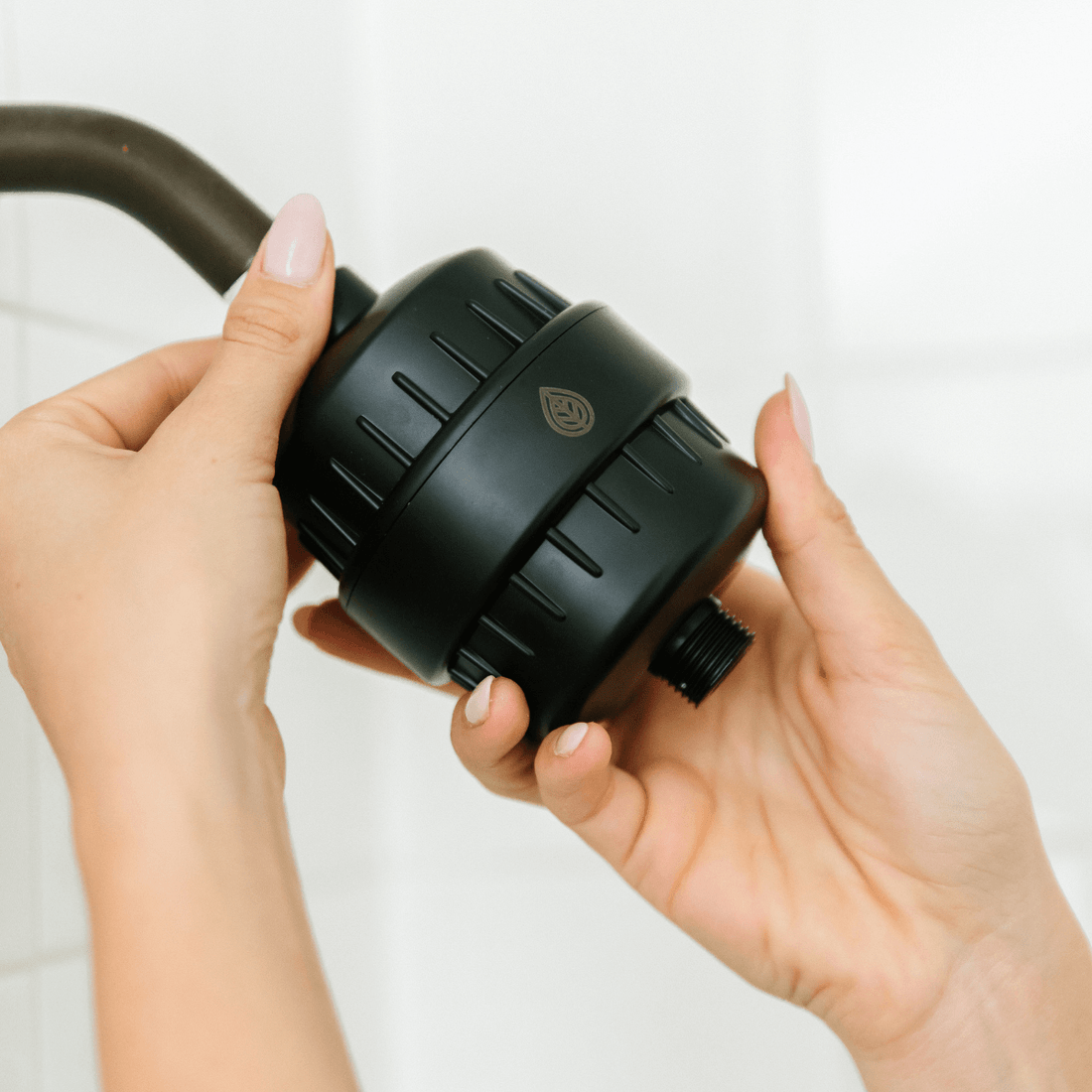

Reduces chlorine and odor using proven, industry-standard filtration media. Starting at $49. Installs in minutes with no tools.
Does not carry NSF/ANSI 177 certification. Does not reduce chloramine. Does not soften water. Does not remove PFAS, fluoride, or heavy metals.
We are a water treatment company, not just a filter brand. If a shower filter is what you need, we will sell you one. If you need more, we have that too — and we would rather tell you the truth than oversell.
A shower filter addresses what touches your skin — but your drinking water requires a different level of filtration entirely. Chlorine, PFAS, lead, and dissolved contaminants require certified systems designed for ingestion.
Replacing Your Cartridge: What to Know
A shower filter is only effective when its cartridge is active. Understanding when and how to replace it is as important as choosing the right filter in the first place.
We recommend replacing your cartridge every 90 days, or when you notice a reduction in water flow — whichever comes first. Your incoming water quality affects how quickly the media depletes. Homes with higher sediment loads or harder water will see shorter cartridge life.

The most convenient way to stay on schedule is to subscribe to automatic cartridge delivery. You set the frequency, we handle the rest — and you save up to 15% on every order. A spent filter is the same as no filter.
Subscribe & Save on Replacement CartridgesMatching the Right Solution to Your Situation
A quick reference guide to help you identify the right starting point based on your specific circumstances:
| Your Situation | The Right Solution | Where to Start |
|---|---|---|
| Renter or apartment dweller — want to reduce chlorine in the shower | Shower filter | Shop Shower Filters |
| Renter — want cleaner drinking water as well | Shower filter + undersink RO (no countertop drilling required with our dual-faucet option) | Shop Apartment Solutions |
| Homeowner — chlorine taste and odor throughout the home | Shower filter as a starting point; whole-home filtration as the long-term solution | Learn About Whole-Home Filtration |
| Homeowner — hard water, scale buildup, dry skin and hair | Whole-home water softener and filtration | Book a Free Consultation |
| Homeowner — chloramine, PFAS, or lead concerns | Whole-home filtration with certified point-of-use systems | Book a Free Consultation |
| Not sure where to start | A conversation — no commitment, no pressure | Book a Free Consultation |
Frequently Asked Questions
How long do shower filters last?
Most shower filters last between 3 and 6 months depending on your incoming water quality and how frequently you shower. We recommend replacing your cartridge every 90 days for consistent performance. You will typically notice reduced water flow when the filter is nearing the end of its useful life — that is your signal to replace it.
Do shower filters reduce water pressure?
Quality shower filters are designed to maintain comfortable water pressure while filtering. Most users report little to no noticeable change. If you experience significantly reduced pressure from the start, it typically indicates poor filter design. If pressure drops over time during use, it usually means the cartridge has accumulated sediment and needs replacement.
Can shower filters help with eczema or sensitive skin?
By reducing chlorine — a known skin irritant — many customers with sensitive skin, eczema, or dermatitis report improvement after installing a shower filter. The most significant results tend to occur when chlorine is the primary irritant. If hard water is also a contributing factor, a shower filter alone may not fully resolve the issue, since it does not remove hardness minerals.
What's the difference between a $50 shower filter and a $150 shower filter?
In most cases, the core filtration media is the same — KDF55, activated carbon, calcium sulfite. The price difference is typically driven by branding, packaging design, and marketing investment rather than meaningful differences in filtration performance. The exception is filters that hold NSF/ANSI 177 certification, which reflects the cost of independent laboratory testing. Always verify certification claims directly on the NSF or WQA websites before paying a premium.
Is a shower filter worth it for well water?
Well water is not treated with chlorine, so the primary benefit of most shower filters does not apply in this context. Well water challenges — iron, sulfur, manganese, hardness — require whole-home treatment systems tailored to your specific water profile. If you are on well water, the right starting point is a water test and a consultation rather than a shower filter.
How do I know if my water uses chlorine or chloramine?
Check your water utility's annual Consumer Confidence Report (CCR) — it will specify which disinfectant is used in your distribution system. You can also call your local utility directly. The fastest option is to use our AI Water Concierge: enter your zip code and it will pull your local water data and identify what you're dealing with in under a minute.
Do shower filters remove chloramine?
Standard shower filters are not effective against chloramine. Chloramine requires significantly more contact time than shower flow rates allow. Vitamin C media can partially neutralize chloramine but requires cartridge replacement every 2–4 weeks. If your municipality uses chloramine, a whole-home filtration system with catalytic carbon media is the correct solution.
Do shower filters soften hard water?
No. Shower filters do not remove calcium or magnesium — the minerals responsible for water hardness. Reducing chlorine can make water feel slightly softer on skin for some users, but this is not water softening. Hard water requires a water softener or whole-home conditioning system installed at the main water line.
How often should I replace my shower filter cartridge?
Every 90 days, or when you notice a reduction in water flow — whichever comes first. Homes with harder water or higher sediment loads will see shorter cartridge life. Subscribing to automatic cartridge delivery ensures you stay on schedule without thinking about it, and saves up to 15% on every order.
Ready for a Better Shower?
Our 8-Stage Shower Filter reduces chlorine and odor for softer skin, healthier hair, and a cleaner shower experience — starting at $49. Replace the cartridge every 90 days and subscribe to save up to 15%.