
What's actually in your city water. And which filtration system removes it.
Municipal water meets EPA minimums — but legal isn't the same as optimal. This guide walks you through the six contaminant categories present in most city water, what each one actually does, and how whole-home filtration addresses them at every tap.

City water passes EPA tests. That's not the same as clean.
The six contaminant categories present in most city water.
Municipal water commonly contains six categories of contaminants that treatment plants either introduce, can't fully remove, or don't address at all: chlorine and chloramine disinfectants, disinfection byproducts (DBPs), PFAS, lead and heavy metals, hardness minerals, and microplastics. Your water starts at a treatment plant where it gets disinfected, filtered for sediment, and tested against EPA standards — and that treatment does a solid job of preventing waterborne disease. But it doesn't get everything out. This guide is part of our broader whole-home water filtration reference.
GoodFor is a consultation-first water company co-founded by Jane Emma and Boris Jabotinsky, a Licensed Master Plumber (CSLB #1102129) who leads our technical standards. Our team of licensed professionals reviews your local water quality and matches you to a WQA Gold Seal certified system. Here's what we actually see when we review municipal water reports with homeowners.
Chlorine and Chloramine
Your water utility adds disinfectants — either chlorine or chloramine — to kill bacteria in the distribution system. Chlorine is the one most people recognize by smell. It dissipates fairly quickly and is straightforward to filter. Chloramine is different. It's a chlorine-ammonia compound that's much more stable, which is exactly why utilities love it — and exactly why it's harder to remove at home.
This is where most whole-home systems fall short. Many filters you'll find online, including popular direct-to-consumer brands, use standard granular activated carbon (GAC) as their primary media. GAC handles chlorine reasonably well. It does not handle chloramine effectively. Chloramine requires catalytic carbon — a more advanced media with a different internal structure that breaks the chlorine-ammonia bond.
Even within catalytic carbon, performance varies. Most catalytic carbon systems on the market are rated for lower chloramine concentrations and shorter service lives, which means the media saturates faster than you'd expect — leading to residual chloramine leaking through to your taps, shower, and appliances. You might not taste it. You're still bathing in it.
This is where Clearess®, GoodFor's proprietary catalytic carbon media, stands apart. Some municipalities push chloramine concentrations higher during seasonal demand or after weather events, and a system rated for 4 ppm handles those spikes without breaking a sweat. If you're currently using a pitcher filter or a refrigerator cartridge, those use basic carbon that's even less effective than the GAC in most whole-home systems — so the gap between what you have now and what a Clearess® system delivers is substantial.
A whole-home chloramine filter with the right media addresses it at every tap, every shower, and every appliance — not just the kitchen faucet.
Simple disinfectant
- Dissipates quickly in open air
- Standard carbon removes it
- Recognizable by smell at the tap
Chlorine + ammonia compound
- Persistent through plumbing
- Standard carbon can't remove it
- Requires catalytic carbon media
Disinfection Byproducts (DBPs)
When chlorine or chloramine reacts with natural organic matter already present in the source water, it creates a category of chemicals called disinfection byproducts — including trihalomethanes (THMs) and haloacetic acids (HAAs). The disinfectant does its job killing bacteria, but the chemical reaction leaves behind new compounds that weren't in the water before treatment.
The EPA regulates these — but the gap between "legal" and "ideal" is enormous. The EPA's maximum contaminant level for total trihalomethanes is 80 parts per billion. The Environmental Working Group's health guideline, based on independent peer-reviewed research, is 0.15 ppb.
Your shower may be a bigger exposure than your drinking glass.
Most people think of water contamination as a drinking water problem. It's not — or at least, it's not only that. Your shower may actually be a bigger source of exposure than your kitchen faucet.
When you take a hot shower, three things happen at once.
Inhalation
Heat causes chlorine, chloramine, and THMs to vaporize into the steam you breathe — going directly into your lungs and bloodstream, bypassing digestion.
Dermal Absorption
Warm water opens pores. Your skin absorbs chlorine and DBPs through direct contact for the entire ~8-minute average shower.
Enclosed Space
Vaporized compounds concentrate in the stall air around you — continuous exposure throughout the shower.
An undersink filter or a pitcher does nothing for this exposure. Neither does a fridge filter. This is the single biggest reason whole-home filtration matters — it treats the water before it reaches your shower head, your bathtub, and every other outlet in the house.
The Cancer Research — What We Know and What's Still Building
Evidence: Strong A 2025 systematic review and meta-analysis published in Environmental Health Perspectives (Helte et al., 2025) found THM exposure associated with increased risk of bladder and colorectal cancer at levels below current US and EU regulatory limits. The EPA itself classifies several trihalomethanes as possible human carcinogens.
Evidence: Emerging A study in Hartford, Connecticut found that women diagnosed with breast cancer had 50–60% higher levels of organochlorines — a category that includes chlorination byproducts — in their breast tissue compared to women without breast cancer. A large Finnish cohort study of over 621,000 people found a modest but statistically significant association between chlorinated drinking water and breast cancer. Other major studies, including the Long Island Breast Cancer Study, found no significant link. The breast cancer connection is not settled science.
You don't need a definitive breast cancer link to justify reducing your family's exposure to chlorine disinfection byproducts. The bladder and colorectal cancer evidence is strong. The overall direction of the research is clear. And reducing exposure through whole-home filtration is a straightforward, well-supported step.
We wrote a full breakdown of the chlorine and cancer research, including the specific studies and their limitations, in our guide: Chlorine in Water and Cancer Risk.
PFAS, lead, hardness, and microplastics.
PFAS
PFAS have been found in water systems across the country. The EPA finalized its first enforceable limits in 2024, and many utilities are still working toward compliance.
The honest answer: no whole-home system from any manufacturer currently holds NSF/ANSI 53 certification for PFAS removal at the point of entry. Certified PFAS reduction requires an undersink RO. Any company claiming otherwise should be asked for the documentation.
Lead
Lead doesn't come from the treatment plant. It leaches into water from aging service lines, solder joints, and brass fixtures between the municipal main and your faucet. The EPA action level is 15 ppb — but the American Academy of Pediatrics has stated there is no safe level of lead exposure for children.
A whole-home system with ion exchange resin can help address dissolved lead by design, and a certified undersink RO adds another layer of verified protection at the drinking tap.
Hard Water Minerals
This one isn't a health concern — it's a quality-of-life issue. Calcium and magnesium cause scale buildup, white spots on glass, stiff laundry, and dry skin and hair.
Hardness above 7 GPG is generally considered hard. Water softening addresses it through ion exchange, while salt-free conditioning inhibits scale without removing the minerals. Different tradeoffs depending on your water.
Microplastics
Microplastic particles have been identified in treated municipal water. A 2024 PNAS study (Qian et al., 2024) found nanoplastics in bottled water at concentrations far higher than previously estimated. Tap water isn't exempt.
Whole-home filtration with advanced carbon media can reduce particulate matter, though no NSF/ANSI standard currently certifies microplastic removal at the point of entry.
"Meets EPA standards" and "optimized for your family" are not the same thing.
The EPA sets Maximum Contaminant Levels (MCLs) — the legal limits for what's allowed in your drinking water. Your utility is required to meet them, and they're enforceable. That matters.
But MCLs aren't purely health-based numbers. They factor in what's technically feasible to treat, what it costs, and what current technology can achieve at scale. That means the legal limit is often significantly higher than what independent health organizations consider ideal for long-term exposure.
The Environmental Working Group maintains a public tap water database where you can search your specific utility and compare its results against both EPA MCLs and stricter health-based guidelines. In many cases, a contaminant that's "within EPA limits" exceeds the level at which researchers have observed health effects. The trihalomethane example above — 80 ppb legal limit vs. 0.15 ppb health guideline — is one of the starkest, but it's not the only one.
None of this means your water is dangerous. It means the gap between "passes regulatory testing" and "optimized for your family's health" is real — and closing that gap is exactly what whole-home water filtration does.
You can look up your own utility's results at EWG's Tap Water Database or find your Consumer Confidence Report at EPA.gov.
Find out what's actually in your city water.
Type your ZIP code into the Concierge and we'll pull your local utility's most recent water quality data, walk you through what each contaminant means in plain English, and tell you what — if anything — is worth filtering. No account, no email gate, no pressure.
Whole-home city water filtration, end to end.
A whole-home system — also called a point-of-entry (POE) system — connects directly to your main water line before the water heater and before any branch lines split off to individual fixtures. Every drop of water that enters your house passes through it. That means filtered, treated water at every faucet, every shower, every appliance, every hose bib. Not just the one outlet where you installed a pitcher.
This is a fundamentally different approach from the point-of-use (POU) filters most people start with — pitcher filters, faucet attachments, fridge cartridges. Those protect a single outlet. They do nothing for the water you shower in, wash your clothes with, or run through your dishwasher and water heater.
What a whole-home system handles in city water
Chlorine and chloramine — Advanced catalytic carbon media (like Clearess®, GoodFor's proprietary catalytic carbon) reduces both chlorine and chloramine at every water outlet. Standard granular activated carbon handles chlorine but struggles with chloramine. The media type matters more than most people realize.
Taste, odor, and aesthetic issues — The same media that handles disinfectants also takes care of the chemical taste and smell many city water homeowners have simply gotten used to.
Hardness — Ion exchange resin removes calcium and magnesium, preventing scale and delivering true soft water. Salt-free systems take a different approach — using Template Assisted Crystallization (TAC) to inhibit scale without removing the minerals. If you're deciding between the two, our salt-free vs. salt-based comparison breaks down the tradeoffs.
Select heavy metals and organic compounds — Ion exchange resin can, by design, also help address dissolved metals including lead and barium. Advanced carbon media reduces many disinfection byproducts (THMs, HAAs) by design as well.
What a whole-home system won't do
No single whole-home system replaces everything. Be clear about what requires a different solution:
PFAS and pharmaceuticals — Certified removal of PFAS, pharmaceuticals, and emerging contaminants at the drinking tap requires an undersink reverse osmosis system rated to NSF/ANSI 53 and 401. No whole-home system from any manufacturer currently holds these certifications at the point of entry.
Bacterial disinfection — Your municipal treatment plant handles this. Whole-home carbon systems are filtration devices, not disinfection devices.
The most comprehensive approach for city water is two layers — a whole-home system treating everything at the point of entry, paired with a certified RO system at the kitchen sink for drinking water purification. That's the strategy we recommend for most homes.
Why media lifespan matters more than most people realize.
The filter media inside the tank is where the actual work happens. And how long that media lasts determines whether you're buying a system that works for your home — or signing up for a recurring service plan.
Most traditional service-model water treatment companies use systems designed around regular filter replacements — typically every 6 to 12 months. That's not a flaw in the product; it's the business model. Recurring filter sales and annual service contracts are how those companies generate ongoing revenue. The system is priced to get you in the door. The filters are priced to keep you paying.
GoodFor's approach is different. Our whole-home Clearess® systems are built around media that lasts. The Hydronex C, for example, uses Clearess® catalytic carbon rated for approximately 2.6 million gallons at 0.5 ppm chlorine — that's approximately 18–20 years for a typical residential home. No scheduled filter replacements during that lifespan. No annual service contracts. No subscription.
- $150–$300/year in filters & service
- Annual service contracts
- Business model: recurring revenue
- No scheduled filter replacements
- Salt only on softening systems
- Limited Lifetime Warranty
The only ongoing maintenance on a salt-based system like the Hydronex C is replenishing the salt — nugget or pellet, added as needed. That's it. The media, the resin, the tank — all covered under a Limited Lifetime Warranty for the original purchaser.
When you're evaluating systems, ask this question: is this company making money when my system works, or when it needs service? The answer tells you a lot about how the system was designed.
GoodFor systems for city water.
Our team reviews your local water quality and matches you to a WQA Gold Seal certified system. For approximately 95% of homes on municipal water, the conversation starts in one of three places.
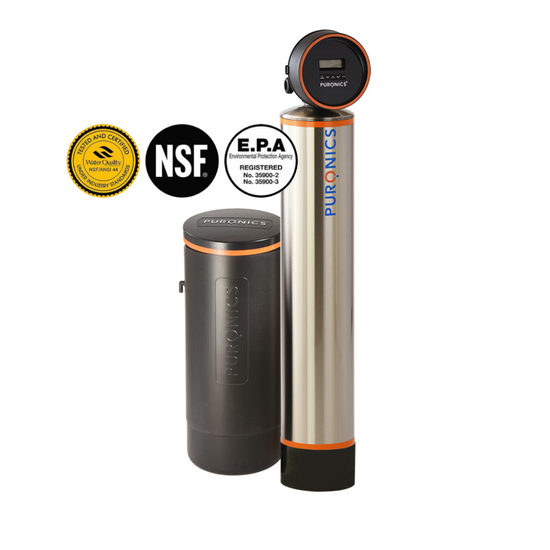
Hydronex C
Whole-home filtration and softening in a single unit. Handles chloramine, chlorine, hardness, and by design also helps address THMs and trace dissolved metals.

FiltraMax C
Same Clearess® media and resin as Hydronex C. 100% food-grade 316L stainless steel tank. Built-in 5-micron AltaPure™ sediment filter.

Goodspring C
Clearess® media + ScaleMax™ scale inhibition. No salt, no electricity, no drain. Does not soften water — inhibits scale formation while preserving minerals.

Add certified drinking water protection.
The most effective city water strategy is two layers working together: a whole-home system treating every drop at the point of entry, plus a certified reverse osmosis system at the kitchen tap for the water your family actually drinks and cooks with.
GoodFor's MicroMax 8500 is a 5-stage advanced RO system and the only product in our lineup certified for PFAS, pharmaceuticals, and emerging contaminants. It picks up exactly where the whole-home system leaves off.
- PFAS (PFOA/PFOS): 99% reduction · NSF/ANSI 53
- Lead: 96.3% reduction · NSF/ANSI 53
- Fluoride: 96.5% reduction · NSF/ANSI 58
- Pharmaceuticals: NSF/ANSI 401 certified
- Full certification stack: NSF/ANSI 42 · 53 · 58 · 401 · 372 · CSA B483.1 · WQA Gold Seal
Get a free city water consultation.
Our licensed team will pull your local water quality data, walk you through what it means, and match you to the right system for your home — no pressure, no generic recommendations, no hidden costs.
City water filtration FAQ.
Is city water safe to drink?
City water in the United States is regulated by the EPA under the Safe Drinking Water Act and must meet Maximum Contaminant Levels for over 90 contaminants. For the vast majority of people, it is safe to drink. But "safe by regulatory standards" and "optimized for your family's health" are different benchmarks. Contaminants like disinfection byproducts, PFAS, and trace lead can be present at levels that are legal but exceed independent health guidelines from organizations like the Environmental Working Group. Whole-home filtration paired with a certified undersink RO system closes this gap.
What does a whole house water filter remove from city water?
A whole-home system matched to municipal water typically reduces chlorine, chloramine, taste and odor compounds, and disinfection byproducts through advanced carbon media. Systems with ion exchange resin also remove hardness minerals (calcium and magnesium), barium, and radium. By design, these systems can also help address dissolved metals and certain organic compounds. Certified PFAS and pharmaceutical removal requires a separate undersink reverse osmosis system rated to NSF/ANSI 53 and 401.
Do I need a whole house filter if I already have an undersink filter?
An undersink filter protects a single faucet. A whole-home filter treats every outlet in the house — including showers, bathtubs, washing machines, dishwashers, and outdoor hose bibs. Chloramine and disinfection byproduct exposure during showering through inhalation and skin absorption is well-documented. If your goal is comprehensive protection, both systems serve different and complementary roles.
How long does a whole house water filter last?
It depends entirely on what's inside the tank. Traditional service-model systems use cartridge filters that need replacing every 6 to 12 months. GoodFor's Clearess® media is rated for approximately 2.6 million gallons at 0.5 ppm chlorine — approximately 18–20 years for a typical residential home with no scheduled filter replacements. Salt replenishment for softening systems is the only regular maintenance.
How much does a whole home water filtration system cost?
GoodFor doesn't publish system pricing upfront because the right system — and therefore the cost — depends on your local water quality, home size, number of bathrooms, and specific concerns. A free consultation with our team includes a water quality review, system matching, and fully transparent pricing with no hidden fees. We'd rather give you an accurate number than a misleading range.
Is a water softener the same as a water filter?
No. A water softener uses ion exchange to remove hardness minerals (calcium and magnesium), which prevents scale buildup and delivers soft water. A water filter uses carbon or other media to reduce chemical contaminants like chlorine, chloramine, and organic compounds. Some systems — like the GoodFor Hydronex C — combine both filtration and softening in a single unit, but the two functions are distinct.
What is the difference between chlorine and chloramine in city water?
Chlorine is a straightforward disinfectant that dissipates relatively quickly and is easy to remove with standard carbon filtration. Chloramine is a compound of chlorine and ammonia that's much more persistent — it lasts longer in the distribution system, which is why utilities use it, but it requires catalytic carbon media to reduce effectively. Standard granular activated carbon won't cut it. If your utility uses chloramine, make sure any whole-home system you're considering uses media specifically rated for chloramine at your local concentration levels.